


Ultrasonic precision spraying machine
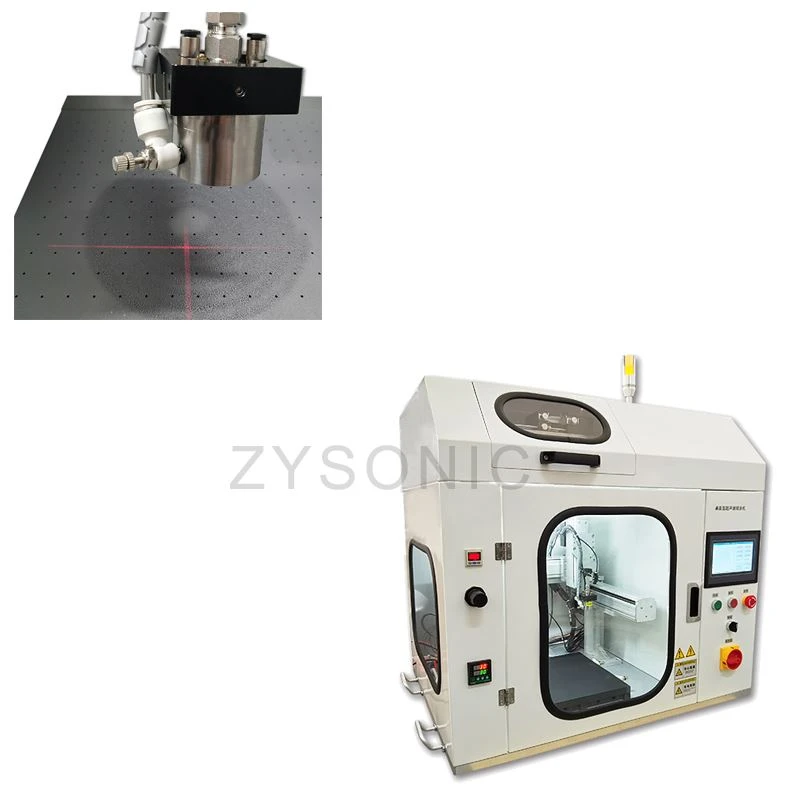
It is suitable for qualitative test in scientific research laboratory, small batch production and small area film production.
Ultrasonic spraying is a kind of atomization spraying, which uses the piezoelectric effect to convert electric energy into high-frequency mechanical energy to atomize the liquid into uniform micron droplets, which can accurately control the droplet size and distribution, use the micro air flow diversion of ≤ 0.15Mpa to make it fall evenly on the substrate to be sprayed, and form a thin-film coating after the solvent evaporates.
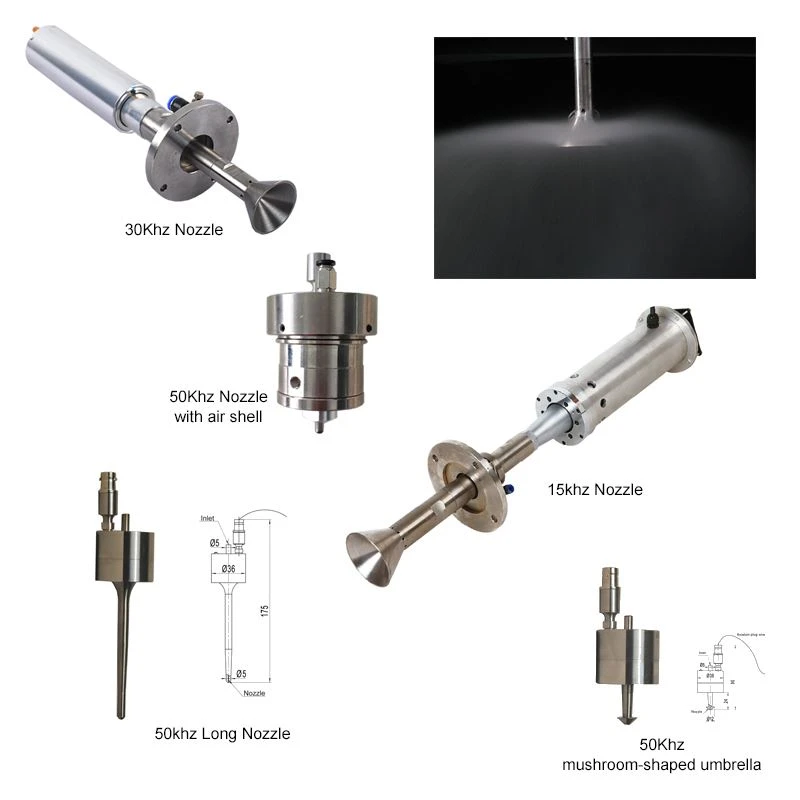
We have developed six different types of nozzles to deal with different applications, namely: wide area type -- wide range type -- scattering type -- gathering type -- long nozzle type -- penetration type -- line spray type. The core material of the nozzle adopts piezoelectric ceramics and titanium alloy, which has the characteristics of self-cleaning and non blocking, and can reduce the downtime in key manufacturing. The liquid supply pipe runs through the whole length of the nozzle. The design of the nozzle ensures that the liquid only contacts the titanium in the nozzle, which makes them particularly resistant to chemical corrosion and provides superior acoustic performance.
The low-speed fog produced by ultrasonic nozzles is usually accompanied by an additional low speed air shaping device to wrap the spray and point it to the substrate, which can precisely control the spray forming fine lines, tapering, wide flat shape and so on. The spray mode can also be installed in series with multiple nozzles to integrate into the complete coating system. Compared with the traditional pneumatic two fluid spraying, ultrasonic atomization spraying can achieve better uniformity, thinner coating thickness and higher precision. At the same time, because the ultrasonic nozzle can atomize without the assistance of air pressure, the use of ultrasonic spraying can significantly reduce the paint splash in the spraying process and achieve the purpose of saving paint. The paint utilization rate of ultrasonic spraying is more than 4 times that of traditional two fluid spraying.
Common problems of traditional spraying:
1. There is no self-cleaning function, so it is troublesome to clean the nozzle.
2. When the atomizing nozzle is too thin, it is easy to cause nozzle blockage.
3. The uniformity of atomized particles is poor, and the particle size is determined by the nozzle.
4, the impact of the spray will cause splashing and waste of raw materials.
5. The nozzle flow cannot be accurately controlled and sprayed continuously at a low flow rate.
Advantages of ultrasonic spraying:
1. High stability - made of high-performance titanium alloy and stainless steel, it has strong adaptability, corrosion resistance, no pressure, no noise, no nozzle wear and blockage, and high uniformity of atomized particles.
2. energy saving and environmental protection - the impact of spray is very small, which will not cause liquid splash, and can reduce raw material waste and air pollution caused by reverse spray.
3. controllable molding. It can precisely control the atomization flow rate, continuous spray with low flow rate, and easy to control and shape spray shape. Through combination, the atomization amount can meet any requirements of users.
4. Easy maintenance - the liquid is transported to the nozzle by gravity or low-pressure pump to realize continuous or intermittent atomization. No cooling water is required during atomization, with low energy consumption, simple equipment, low failure rate and daily maintenance free.
5. Wide application - the size of atomized particles is determined by ultrasonic frequency and has nothing to do with nozzle diameter. It is difficult to block the nozzle by maintaining ultrasonic oscillation during atomization. The nozzle can be applied to various solutions, and even atomize sewage, chemical liquid and oil mucus.