


Ultrasonic metal melt treatment system is to use the cavitation effect of ultrasonic in molten liquid, which can cut off the damaged dendrite, impact the solidification front, increase the stirring diffusion, homogenize the microstructure, increase the tensile strength of metal materials and improve the metal toughness. The grain size is small and the boundary area is large, which can effectively prevent dislocation and intergranular slip, that is to say, more force is needed to make the material fracture. The finer the grain size, the smaller the dendrite spacing, the higher the yield strength and the better the hardness.
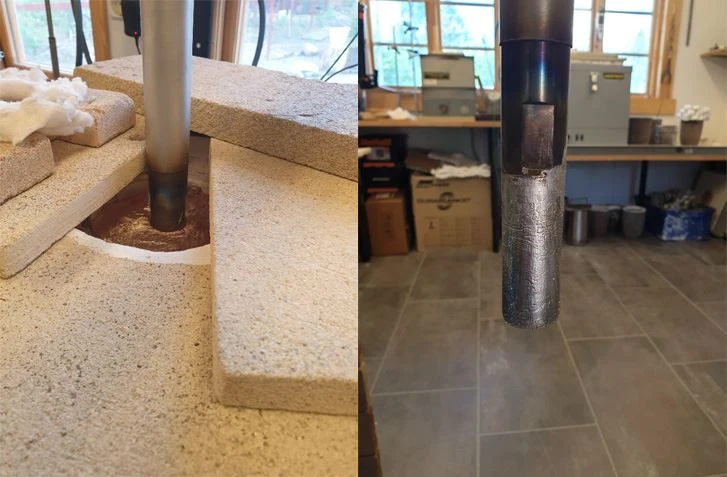
The ideal microstructure of the ingot is that there are uniform and fine equiaxed grains on the whole cross section of the ingot, which is due to the small anisotropy of equiaxed grains, uniform deformation, excellent performance and good plasticity during processing, which is conducive to casting and subsequent plastic processing. In order to obtain this kind of structure, the most important method is to use ultrasonic metal melt equipment to refine the melt.
The function of ultrasonic melt treatment system
Remove impurities: it is very difficult to float up small inclusions in molten steel, and it is easier to float up only when they gather. Ultrasonic standing wave can make the inclusion powder in the solution layered and agglomerated successfully by ultrasonic melt equipment.
Ultrasonic degassing: ultrasonic has a great effect on removing gas from molten metal. Ultrasonic elastic vibration can completely degass alloy in a few minutes. When ultrasonic vibration is introduced into molten metal, cavitation is found, which is caused by the fracture of the continuity of liquid phase, and the gas dissolved in liquid metal will be concentrated in it. The elastic vibration of ultrasonic wave causes the bubble core to grow up until it can be discharged from molten metal smoothly.
Improve the quality of the casting: ultrasonic metal solution equipment can be used in the mold to improve the surface quality of the slab. Ultrasonic vibration can be used for billet, bloom and slab, and it is not necessary to slide negatively when ultrasonic vibration is used. When casting small square and bloom, the surface of the billet can be obtained by ultrasonic vibration.
Grain refinement: when ultrasonic vibration solidification process is used to produce castings, ultrasonic wave will produce positive and negative alternating sound pressure and form jet. Meanwhile, acoustic and micro acoustic flow will be generated due to nonlinear effect, while ultrasonic cavitation will produce high-speed micro jet at solid and liquid interface. Cavitation effect in ultrasonic liquid can cut off the broken dendrites, impact the solidification front, increase the stirring diffusion, and can purify the structure, refine the grains, and homogenize the structure. In addition to the mechanical action caused by vibration, the other important role of ultrasonic vibration solidification is to improve the effective supercooling degree of metal liquid, reduce the critical nucleation radius, increase nucleation rate and refine the grain.