Application Of Ultrasonic Vibrating Rod in Water Treatment
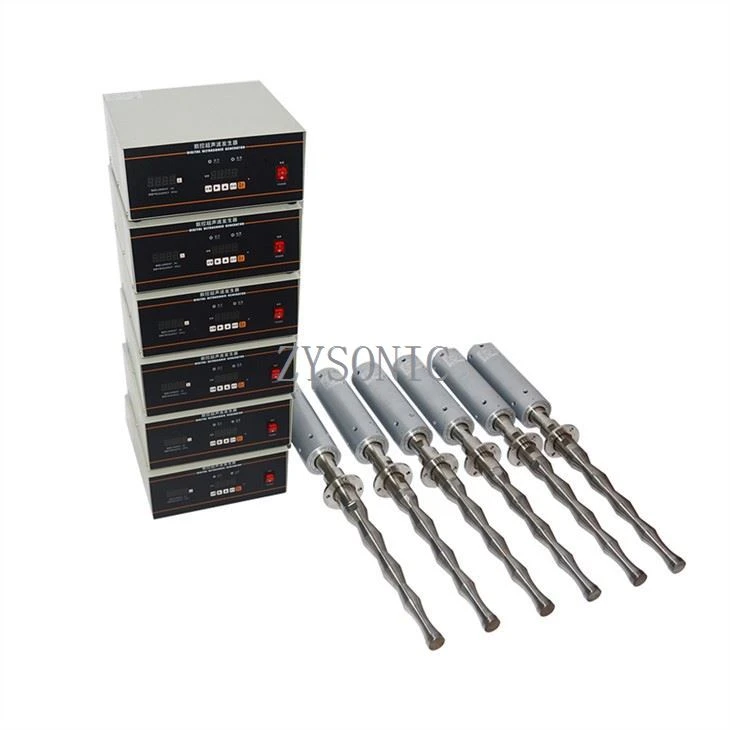
Ultrasonic vibrating rod energy-concentrating ultrasonic probe concentrates the energy, and can obtain strong sound intensity on the ultrasonic radiation end surface. Due to the energy-gathering effect of the horn, the sound energy density is increased; the reactor can be designed according to the size of the sound energy density; The transmitting end face of the probe is generally designed to be detachable, so that a probe with a suitable end face size can be selected at any time according to the required sound intensity. At the same time, when the probe is severely corroded by cavitation, only the end needs to be replaced instead of the expensive one. The whole vibrator. Ultrasonic vibrating rods can be used to treat a variety of difficult-to-degrade organic wastewater. It has been used to contain monocyclic aromatic compounds, polycyclic aromatic hydrocarbons, phenols, chlorinated hydrocarbons, chlorinated hydrocarbons, organic acids, dyes, alcohols, ketones, etc. Research on wastewater treatment and achieved good results.ultrasonic-transducer/15khz-ultrasonic-welding-transducer-with.html In the actual industrial wastewater, the equipment has been used to treat papermaking wastewater, printing and dyeing wastewater, tannery wastewater, coking wastewater, pharmaceutical wastewater, landfill leachate, etc., and has achieved good results.
In addition, in some landscape lakes and rivers, ultrasonic vibrating rods can also be used to kill and inhibit algae. The mechanical effect, cavitation effect, thermal effect and acoustic current effect of ultrasonic waves break the algae, break the chemical bonds in the material molecules, act on the outer wall of the algae and rupture it, so as to achieve the effect of elevating and breaking the algae vacuole, extinction or growth inhibition, etc. , Cause a series of biological effects, cavitation causes the microbubbles existing in the liquid to expand rapidly and then suddenly close, generating shock waves and jets to achieve the purpose of eliminating algae and balancing the water environment and ecology. Low-intensity ultrasound destroys the structure and function of phycobilisomes, interferes with the synthesis of chlorophyll, and achieves the purpose of inhibiting the growth of algae. With its rich product experience and solid knowledge, the company provides users with warm and thoughtful service, which is well received by users.
Ultrasonic vibrating rods are also called ultrasonic vibrating rods.
Compared with traditional ultrasonic vibrating plates, it has the characteristics of wider application range and longer service life. In industrial applications, the use of ultrasonic vibrating rods for cleaning, extraction, chemical reactions, anti-scaling, water treatment, etc., is a very mature and widely used technology. Ultrasonic vibrating rod uses the alternating period of positive and negative pressure existing in the transmission process of ultrasonic waves. In the positive phase, the medium molecules are squeezed to increase the original density of the medium; in the negative phase, the medium molecules are sparse and discrete, and the medium density Decrease. Ultrasonic vibrating rods can uniformly generate ultrasonic waves around 360°, and the energy output is not affected by load changes such as liquid level and temperature difference. Ultrasonic vibrating rods generally include high-power ultrasonic transducers, horns, and tool heads (transmitting heads). ), used to generate ultrasonic vibration and emit this vibration energy into the liquid. The transducer converts the input electrical energy into mechanical energy, that is, ultrasound. Its manifestation is that the transducer stretches back and forth in the longitudinal direction, and the amplitude is generally a few microns. This amplitude power density is not enough and cannot be used directly. The horn amplifies the amplitude according to the design requirements, isolates the reaction solution and the transducer, and also plays a role in fixing the entire ultrasonic vibration system. The tool head is connected with the horn, the horn transmits the ultrasonic energy vibration to the tool head, and then the ultrasonic energy is emitted into the chemical reaction liquid by the tool head