


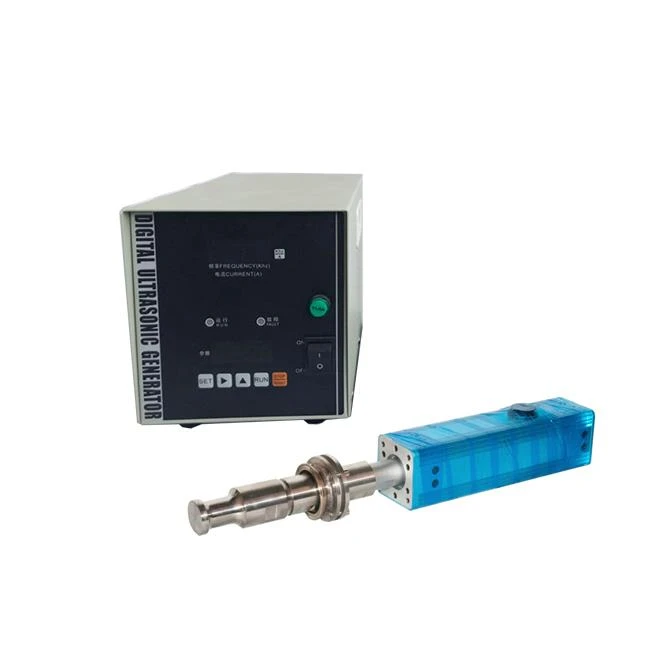
Ultrasonic accelerated catalytic reaction and improved yield have a wide range of applications, mainly from: catalytic on the metal surface, phase transfer catalytic reaction, enzyme catalytic reaction.
Principle of ultrasonic catalytic equipment
The ultrasonic catalytic device consists of two parts: an ultrasonic catalytic system and an ultrasonic drive system (ultrasonic generator).
The ultrasonic catalytic system mainly comprises an ultrasonic transducer, an ultrasonic horn, and an ultrasonic tool head for generating ultrasonic vibration, and the vibration energy is emitted into the liquid.
1.Ultrasonic transducer
Converting the input electrical energy into a mechanical energy representation is that the transducer moves back and forth in the longitudinal direction, typically at a few microns in amplitude.
2.Ultrasonic horn
Due to the insufficient amplitude generated by the ultrasonic transducer, it is necessary to connect the ultrasonic horn, and the amplitude is amplified according to the design, the reaction solution and the ultrasonic transducer are isolated, and the entire ultrasonic vibration device is also fixed.
3. Ultrasonic generator
Generate high frequency and high power current to drive the ultrasonic vibration component to work. The power of the ultrasonic generator is adjustable to suit different operating conditions. A timing controller can also be integrated in the generator to control the ultrasonic vibration time and intermittent time.
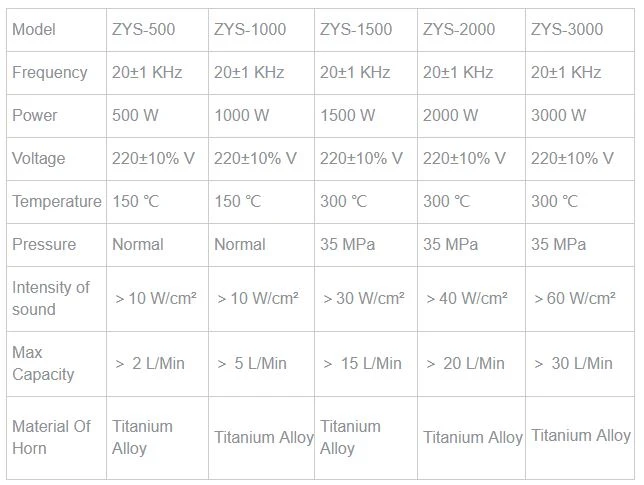
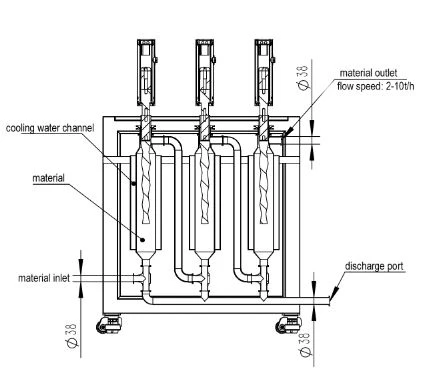
Advantages of ultrasonic catalytic equipment
Improve catalyst dispersibility;
Promoting the solvent to penetrate deep into the solid, producing a so-called inclusion reaction;
Ultrasonic cavitation of the metal surface, the shock wave causes the deformation of the metal lattice and the formation of the internal strain zone, and enhances the chemical reactivity of the metal;
Dispersed reactant system;
Shock waves may damage the structure of the reactants;
The shock wave and the micro jet have a desorption and cleaning action on the solid surface, which can remove surface reaction products or intermediates and catalyst surface passivation layer;
High temperature and high pressure conditions facilitate the cleavage of reactants into free radicals and divalent carbon to form more active reactive species.
Ultrasonic catalytic equipment working environment
Use environment: indoor use
Humidity: ≤85% RH
Ambient temperature: 0°C—40°C
Use space: the distance between surrounding objects and equipment should not be less than 150mm, and the heat dissipation port should not be less than 200mm
Note: Do not move the power supply chassis during use, plug in the power supply or aviation plug directly. If you hear any abnormal noise or abnormality (generator alarm), please turn off the power immediately, and then find the cause of the fault, otherwise it will easily damage the machine or cause an accident.
Hot Tags: ultrasonic catalytic equipment, China ultrasonic catalytic equipment suppliers, manufacturers, factory


