


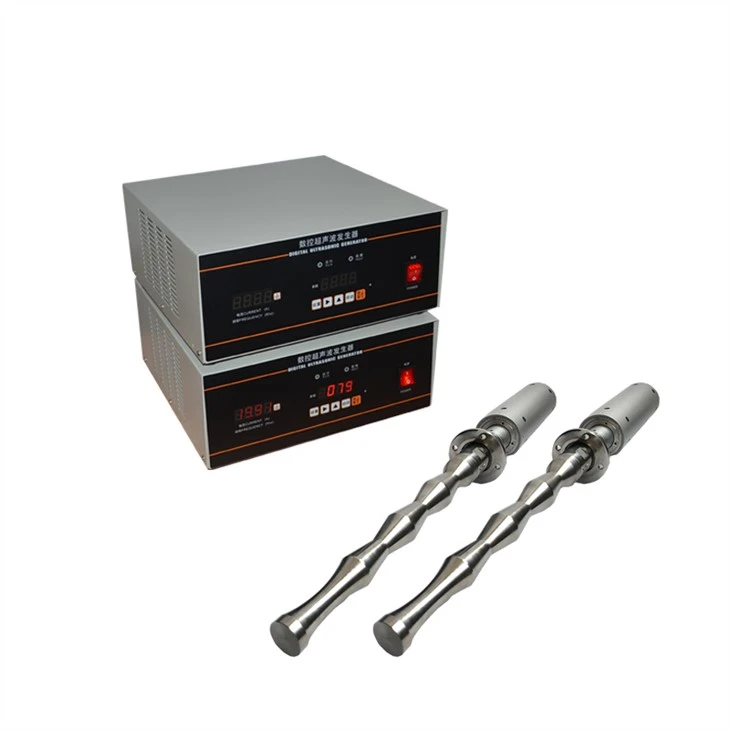
Introduction to emulsification
In different industries, the manufacturing process of emulsions varies greatly. These differences include the components used (mixtures, including various components in solution), emulsification methods, and more processing conditions. An emulsion is a dispersion of two or more immiscible liquids, and high-intensity ultrasonic waves provide that the liquid phase (dispersed phase) is dispersed in small droplets of another second phase (continuous phase). energy.
Both liquids can form different types of emulsions. For example, oil and water. First, an oil-in-water emulsion in which the oil is a dispersed phase and water is a dispersion medium. Second, they can form a water-in-oil emulsion in which water is the dispersed phase and the oil is the external phase. Multiple emulsions may also be formed, including "water-in-oil" emulsions and "oil-in-water" emulsions.

Phacoemulsification is caused by cavitation. The ultrasonic waves passing through the liquid are continuously compressed and expanded. High intensity ultrasound provides the energy needed to disperse the liquid phase. When the pressure is reached, a liquid rupture occurs at a point where the cohesion is weak. After this rupture, an overpressure occurred at the point where the rupture occurred, and some cavities were found. In these cavities, the dissolved gas of the liquid explodes in the form of bubbles in a short time.
In order to stabilize the newly formed droplets of the dispersed phase to prevent coalescence, an emulsifier (surface active, surfactant) and a stabilizer are added to the emulsion. The *final droplet size distribution is maintained at an equal level as when the droplets are ruptured in the ultrasonic dispersion zone.
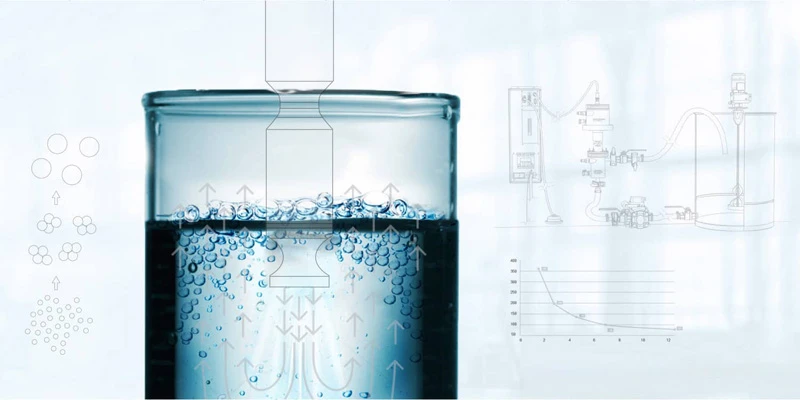
The cavitation process is affected by the frequency and intensity of the ultrasonic wave. The appearance of bulk hollowing depends to a large extent on the presence of undissolved gas in the liquid suspension. The presence of gas seems to act as a catalyst. Under a certain pressure, the formation of the cavity depends to some extent on the development time and the ultrasonic frequency. The phacoemulsification process represents a competition between opposing processes. Therefore, it is necessary to choose the appropriate working conditions and frequency so that the destructive effect dominates.
Advantages of ultrasonic emulsification
The type of emulsion can be controlled.
The power required to produce the emulsion is small.
The emulsion formed is more stable, and some are stable for several months to more than half a year.
The concentration is high, the concentration of pure emulsion can exceed 30%, and the emulsifier can reach 70%.
Low cost, an important feature of ultrasonic emulsification is the ability to produce very stable emulsions with or without emulsifiers.
Ultrasonic emulsification has many advantages over conventional emulsification processes and equipment such as propellers, colloid mills, and homogenizers.
The resulting emulsion has a small average droplet size (0.2 to 2 microns) and a narrow droplet size distribution (0.1 to 10 microns) or narrower.
Hot Tags: oil in water ultrasonic emulsifier, China oil in water ultrasonic emulsifier suppliers, manufacturers, factory


