


Graphene is a honeycomb planar film formed by sp2 hybridization of carbon atoms. It is a quasi-two-dimensional material with only one atomic layer thickness, so it is also called monoatomic layer graphite. As one of the newest nanomaterials found to be the thinnest, strongest, and most conductive and thermally conductive, graphene is called "black gold" and is the "king of new materials." Scientists even predict that graphene will "completely change the 21st century." ". It is very possible to set off a revolutionary new technology and new industrial revolution that has swept the world.


Graphene preparation method
● Mechanical peeling method: The mechanical peeling method is a method of obtaining a thin layer of graphene material by utilizing friction and relative motion between an object and graphene. This method is simple to operate and the resulting graphene typically maintains a complete crystal structure. In 2004, two scientific methods in the United Kingdom used transparent tape to peel off natural graphite to obtain graphene, which was also classified as mechanical peeling method.
Disadvantages: This method was once considered to be inefficient in production and unable to industrialize mass production.
● Redox method: The redox method is to oxidize natural graphite by using a chemical reagent such as sulfuric acid or nitric acid, an oxidizing agent such as potassium permanganate or hydrogen peroxide, to increase the spacing between the graphite layers, and to insert an oxide between the graphite layer and the layer. , graphite oxide (Graphite Oxide) was obtained. Then, the reactant was washed with water, and the washed solid was dried at a low temperature to obtain a graphite oxide powder. The graphite oxide powder is peeled off by a method such as physical peeling or high-temperature expansion to obtain graphene oxide. Finally, the graphene oxide is reduced by a chemical method to obtain graphene (RGO).
Disadvantages: This method is simple to operate, high yield, but the product quality is low. The redox method uses a strong acid such as sulfuric acid or nitric acid, which has a large risk, and must be washed with a large amount of water, with a large environmental pollution.
● (SiC) SiC epitaxy: SiC epitaxy is to sublimate silicon atoms out of the material in a high-temperature environment of ultra-high vacuum, and the remaining C atoms are reconstructed by self-assembly to obtain graphite based on SiC substrate. Alkene.
Disadvantages: This method can obtain high quality graphene, but this method requires higher equipment.
Ultrasonic graphene production
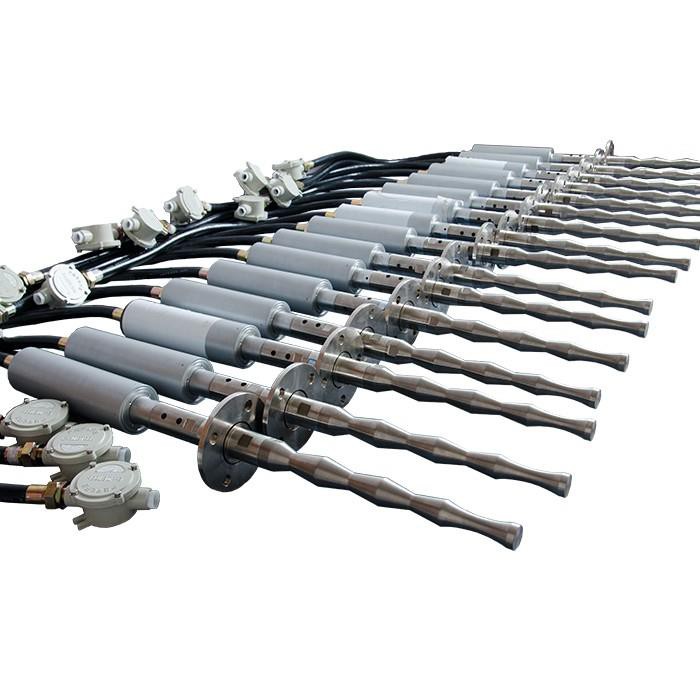
Ultrasonic refers to sound waves with a frequency exceeding 20,000 Hz. Ultrasonic cavitation refers to the propagation of ultrasonic waves in a liquid state, which will generate strong pressure waves in the liquid. These pressure waves will form millions of microscopic bubbles, with high frequency vibration. The bubbles will grow rapidly and then suddenly close. When the bubbles are closed, a strong shock wave is generated due to the collision between the liquids, and thousands of atmospheric pressures (ie, ultrasonic cavitation) are generated around the bubbles. This results in a strong shearing action at the top of the horn, which in turn promotes a range of physical and chemical changes. Ultrasonic exfoliation of graphite to prepare graphene is to uniformly mix graphite powder and intercalation agent in an organic solvent, and then use an ultrasonic water bath for stripping for a certain period of time, centrifugally separating, and filtering to obtain a graphene material. Ultrasonic preparation of graphene dispersing equipment has the advantages of high quality, excellent performance, few defects and low impurity content. In particular, the method is a complete physical process to ensure the perfect performance of graphene.
Power | 1000W | 1500W | 2000W | 3000W |
Frequency | 20Khz | |||
Amplitude/power adjustment range | 50-100% | 20-100% | ||
Temperature | <300℃ | |||
Volume of reactor | 5-100L | |||
Standard Spec | Ultrasonic device + Digital Generator | |||
Optional configuration | Stainless steel reactor, Remote communication interface, flow meter, pump, mechanical mixer | |||
Hot Tags: ultrasonic graphene dispersion production machine, China ultrasonic graphene dispersion production machine suppliers, manufacturers, factory


